We are the Service Employees International Union,
an organization of more than 2.1 million members
united by the belief in the dignity and worth of
workers and the services they provide and dedicated
to improving the lives of workers and their families
and creating a more just and humane society.
The economic crisis -- and the Wall Street excesses and corporate abuses that drove it -- has put a secure retirement at risk for everyone. Instead of cutting pensions for public employees and force more retirees into poverty, we're working together to help deliver retirement security to more people.
The term “public pensions” is often used to describe the traditional defined benefit (DB) pension plans that help deliver retirement security to millions of public sector workers. Unlike 401(k) style defined contribution plans, DB plans provide workers with modest, guaranteed benefits.
Public pension investments also play a vital role in stimulating the US economy and creating jobs. Public pensions have been under pressure in the wake of the recent economic downturn. However, SEIU and our sector union partners are committed to ensuring public pensions are protected, strong and sustainable for current workers and future generations.
Retirement experts agree there must be significant policy intervention if we hope to remain a country where workers can reasonably expect to retire. Federal solutions to America’s
looming retirement security crisis must include bold changes to Social Security and our private sector retirement system.
SEIU members are committed to strengthening Social Security as a priority to deliver retirement security to more Americans. We will work in coalition with labor and progressive allies to strengthen Social Security by making all Americans, particularly the wealthiest 1%, pay their fair share of Social Security taxes, so we can improve benefits for the most vulnerable members of society and ensure the solvency of Social Security for future generations.
The road to retirement has become very rocky for private sector workers as the number of corporations offering secure defined-benefit pension plans steadily declines. More workers are now relying on risky 401(k)-style defined contribution plans for retirement --or have no plan at all. This decline has fueled a looming retirement income crisis that threatens the American Dream for every working family.
SEIU firmly believes that retirement should not be a race to the bottom in America. We are committed to working with allies and policy makers to create new, innovative private sector models that lead to greater retirement security for all workers that don’t have a pension.
"Taft-Hartley plans" refer to the multi-employer pension plans collectively bargained by a union and a group of employers, usually in related industries. Taft-Hartley plans are governed by a trust, half of whose trustees are appointed by the employers, and half by the union. This retirement plan model has enabled tens of thousands of small and medium-sized businesses to provide workers with the traditional defined benefit pensions that used to be standard among larger employers, but have now virtually disappeared in the non-unionized private sector.
Since their creation, a number of federal regulations including the Employee Retirement Income Security Act (ERISA) of 1974 and subsequent amendments have changed the regulation of multi-employer plans.
The three-legged stool of retirement--Social Security, pensions, and personal savings – that once provided retirement security to American workers is broken. The majority of working people have no pension and little to no savings, causing many retirees to rely almost entirely on Social Security, which by itself isn’t enough to keep them out of poverty.
SEIU is committed to working together to deliver retirement security to all workers as part of a broader agenda to fight for social and economic justice for the 99%. Our work includes advocating for a stronger Social Security System, sustainable pensions and new private sector retirement models that will help deliver retirement security to more workers.
Fact Check: Learn the Truth About Retirement Security
Fact 1: Today, more than 70 million American workers do not have any type of employer-sponsored retirement plan.
Fact 2: People of color, young people, and low-income earners have the lowest access rates to employer-sponsored retirement plans.
Fact 3: Only 17% of private and public sector workers have access to traditional defined benefit pensions, which provides retirees with a reliable, modest income.
Fact 4: The Bureau of Labor Statistics estimates that at least 10 percent of Americans age 75 or older will be working or seeking employment by 2018.
Fact 5: Three out of five middle-class new retirees can expect to outlive their financial assets if they attempt to maintain their pre-retirement standard of living. OR The average retired middle-income American will have to reduce their standard of living by 51 percent to avoid outliving their financial assets.
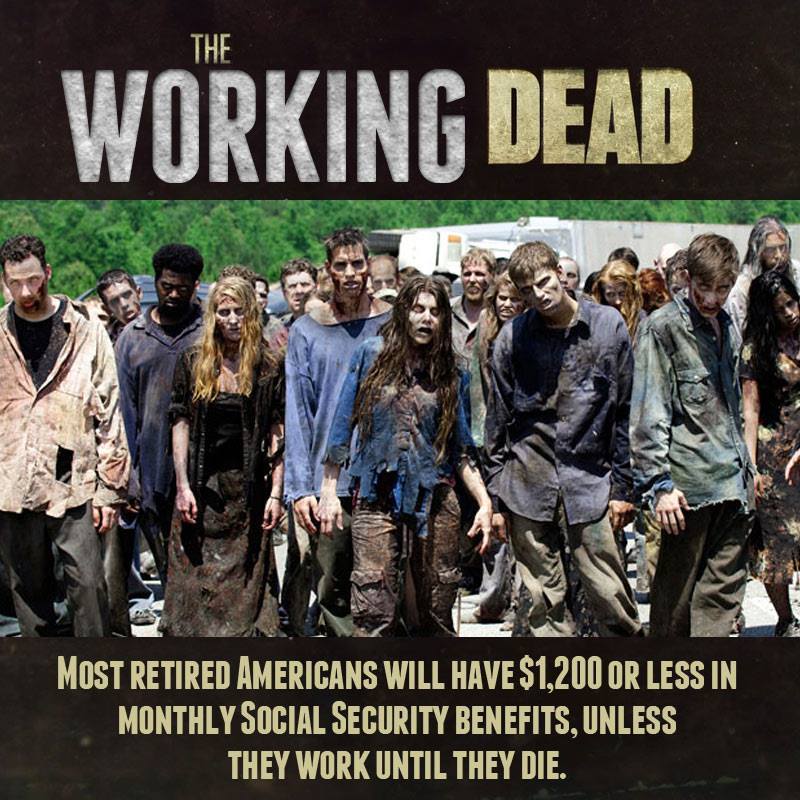
Fact 6: Social Security benefits are less than $1,200 per month for millions of retired low wage workers with no other source of income.
Fact 7: Social Security is largely responsible for the dramatic decline elderly poverty over the last 70 years. Almost 90 percent of all seniors (age 65 and older) receive Social Security; for many, it makes up over half of their income.
Fact 8: Elder poverty rates are twice as high among Blacks and Latinos 65 and older. 19.4 percent of Black seniors and 19.0 percent of Latino seniors have incomes below the federal poverty line.
Fact 9: The wealthiest 1% are not paying their fair share. If everyone contributed the same percentage of their income to fund Social Security, there would be enough funds to sustain and strengthen Social Security far into the future.
Fact 10: Social Security will not bankrupt or ruin our government. In fact, under its current structure, Social Security will remain solvent at least until 2037.
Fact 11: Seven out of 10 public employees get less than $30,000 per retirement.
Fact 12: How financially viable are pensions? Pensions have financially viable for 70 years and were mostly on solid financial ground until the stock market crash.
Fact 13: Pensions do so well that most of the pension dollars paid to firefighters, teachers, and other school employees comes from investment earnings, not contributions by government.
Fact 14: How financially viable are pensions? Pensions have financially viable for 70 years and were mostly on solid financial ground until the stock market crash.
Thursday morning, hundreds of students and activists from around the country rallied for a solution to the student debt crisis outside the Sallie Mae's annual corporate shareholder meeting at their headquarters in Newark, Delaware
It's Asian Pacific American Heritage Month! This year's celebration holds significance for SEIU and our members with the induction of activists Luisa Blue (Chief Elected Officer, SEIU Local 521) and Courtni Pugh (President, SEIU Local 99) into SEIU's International Executive Board (IEB).
It will be decades before young adults reach retirement age, but recent research from the National Institute on Retirement Security (NIRS) finds Millennials are already concerned about their ability to retire.
Currently, undocumented workers contribute about $15 billion a year to Social Security but they don't receive benefits when they reach retirement age due to their undocumented status or, in some cases, migration from the United States.
Retirement experts agree there must be significant policy intervention if we hope to remain a country where workers can reasonably expect to retire. Federal solutions to America’s looming retirement security crisis must include bold changes to Social Security and our private sector retirement system.
SEIU members are committed to strengthening Social Security as a priority to deliver retirement security to more Americans. We will work in coalition with labor and progressive allies to strengthen Social Security by making all Americans, particularly the wealthiest 1%, pay their fair share of Social Security taxes, so we can improve benefits for the most vulnerable members of society and ensure the solvency of Social Security for future generations.
Learn More